Learning for Good
Enterprise pathways for justice-involved young people (14-17)
One-to-one support for young people transitioning from custody, recently released, or at risk of reoffending - helping them make decisions, build self-worth and move toward lawful ways of earning.
Who this is for
Young people aged 14-17 who are transitioning from custody, recently released, or at risk of reoffending, and who are disengaged from school, training or work but open to working one-to-one.
Why this program exists
When a young person comes out of custody, the expectation is that something will be different. In most cases, it is not.
They return to the same environment, the same pressure to make money, and the same limited options. If there is not a realistic way to earn legally, the next decision is already predictable.
This is where most young people fall back into what they already know. Not because they want to, but because it is available and it works in the short term.
Most responses focus on compliance, check-ins or group programs. They have a role, but they do not hold when decisions are being made under pressure.
This program is built for that point.
What we actually do
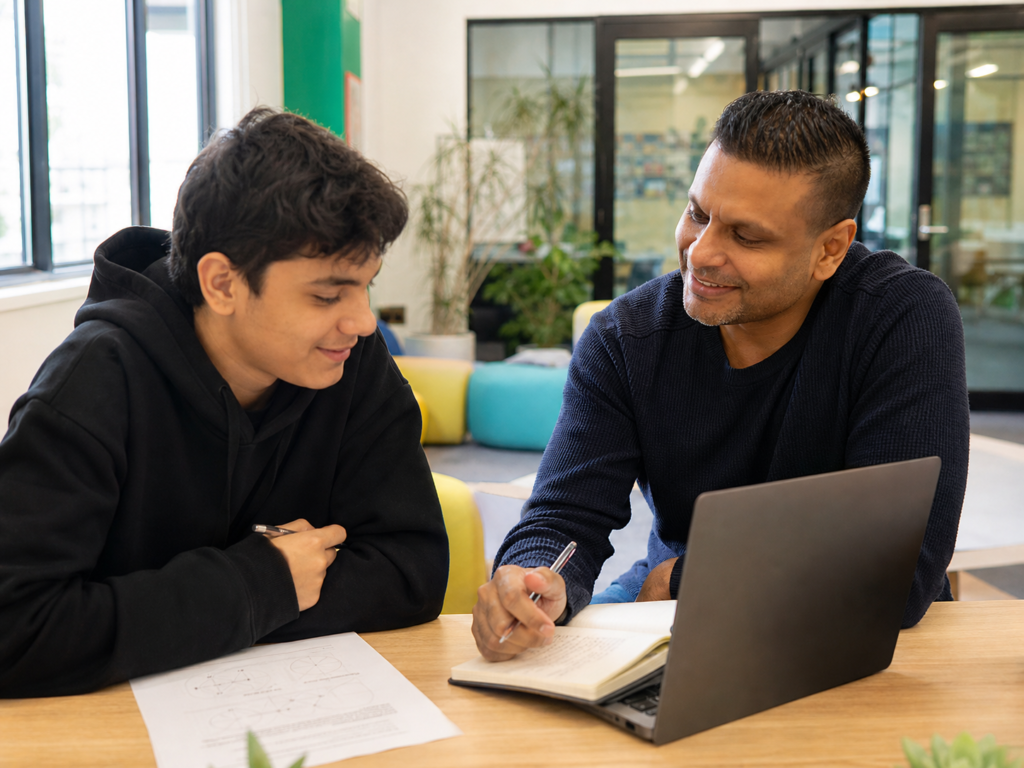
We work one-to-one with young people aged 14-17 who are transitioning from custody or at risk of going back.
Each participant receives 15 hours of structured 1:1 support. That might be delivered over six weeks, or it may take longer depending on what is happening in their life.
Support starts when they are ready. It is not tied to a fixed cohort.
Across the program, up to 20 young people are supported, with a total of 300 hours of structured 1:1 engagement.
Each young person can continue to access mentoring and the BREED Business Centre beyond the structured hours.
This is not a workshop
It is not drop-in support. It is consistent, individual work focused on how a young person is thinking, making decisions and approaching what comes next.
Where it is different
We do not start with employment
We start with how a young person is already operating.
Many of the young people we work with already take initiative, manage risk and find ways to make money under pressure. The issue is not whether they are capable. The issue is how that capability is being used.
Enterprise is the entry point
Not as a business course, but as a way to break down how money is being made now and what it looks like to do that without putting themselves back inside.
If a young person has no realistic way to earn legally, we should not be surprised by what happens next. The work has to start there.
Why this approach works
This is not a new model. Across BREED delivery in 2024-25, 497 individuals engaged in structured programs, including youth in custody, post-custodial programs and at-risk cohorts. 12% of participants were young people in custodial settings, with continued engagement observed as they transitioned back into the community.
When the work is one-to-one and grounded in real decisions, engagement holds.
The difference is not the content. It is the focus. When the work is built around how a young person thinks, responds to pressure and makes decisions, behaviour starts to shift.
What Learning for Good is based on
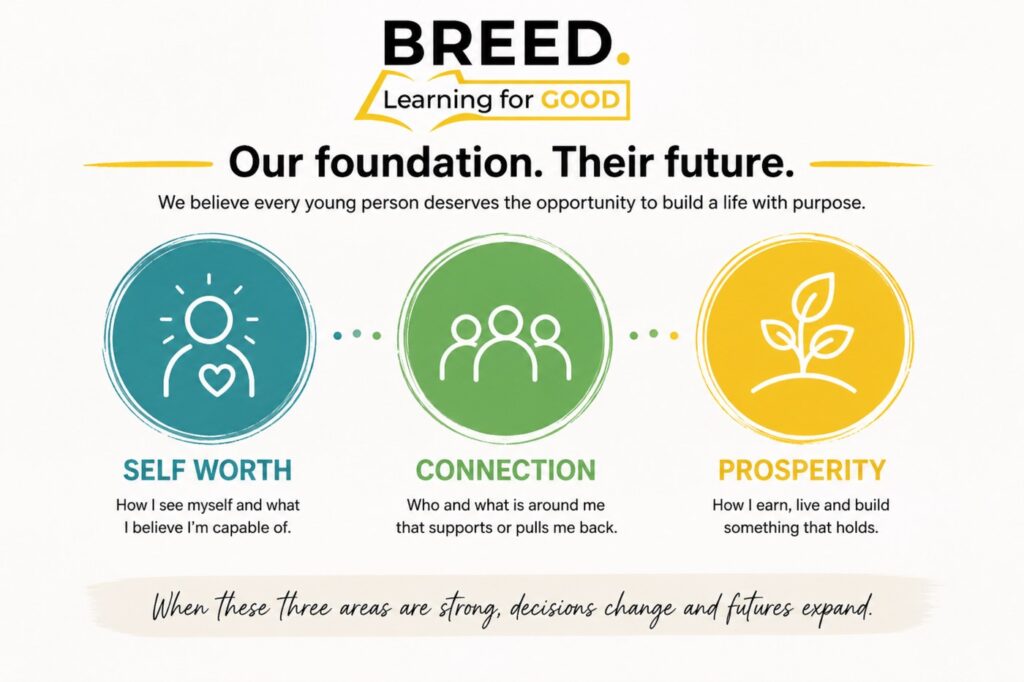
These are not abstract ideas. They are the conditions that sit underneath whether a young person stays engaged or falls back. Employment, training and self-employment matter, but they only hold when these foundations are in place.
What the work focuses on
Self-worth and identity
How the young person sees themselves and what they believe is possible.
Decision-making
Real situations are unpacked, particularly where money, pressure and influence from others are involved.
Enterprise thinking
Risk-taking and initiative are redirected into lawful ways of generating income.
What happens from there
Once that foundation is in place, we work with the young person to define what is realistic.
That might be employment, training, self-employment, or a mix depending on their goals and how they are progressing.
Participants set short-term and longer-term goals, and progress is tracked through sessions, reflection and engagement with pathway opportunities.
We also connect young people into employment and training options and mentoring support where required.

Mentoring is what really makes it work
The 15 hours provides the structure.
We commit to staying connected beyond the structured program. That might mean checking in when things start to slip, supporting a young person as they start work or training, or helping them think through decisions as they come up.
There is no fixed end point for us. That continuity is what allows progress to be maintained rather than lost.
What changes
We are not promising outcomes we cannot control. What we do see, consistently, is measurable change.
Young people become better able to manage pressure, make decisions that do not take them backwards, and move toward lawful ways of earning and participating.
They are more likely to engage with employment or training and less likely to rely on harmful or informal ways of making money. That is where change starts.
This program is delivered with support from the NSW Department of Communities and Justice through the Community Safety Investment Fund.